Abstract
Black pepper (Piper nigrum L.) is a climbing perennial plant in the Piperaceae family. Pepper has been known since antiquity for its use both as a medicine and a spice. It is particularly valued for its pungency attributed to its principal constituent – piperine. This review summarizes the information on the biological source of piperine, its extraction and isolation strategies, physicochemical properties, and pharmacological activity – analgesic, immunomodulatory, anti-depressive, anti-diarrheal, hepatoprotective, etc. The effect of piperine on biotransformation of co-administered drugs is also presented in this review, along with the mechanisms involved in its bioavailability-enhancing effect. Its important medicinal uses, including anti-hepatotoxic, anti-diarrheal, anti-depressive, analgesic, and immunomodulatory effects, besides many other traditional uses, are compiled. Based on an exhaustive review of literature, it may be concluded that piperine is a very promising alkaloid found in members of the Piperaceae family.
Key words: piperine, pepper, extraction, Piper nigrum, bioavailability enhancement
Introduction
Since antiquity, plants have been used as a source of food, spices and medicines. Among all spices, pepper has been widely discussed and named accurately “the king of spices”, due to its characteristic pungency and flavor. Therefore, it is used as an important ingredient in food worldwide. The aroma of pepper is due to the presence of volatile oil, the content of which varies from 0.5% to 7%. Pepper is particularly valued for its pungency attributed to its principal alkaloidal constituent – piperine, the content of which varies among the members of the Piperaceae family. The highest content of piperine has been reported in black pepper (Piper nigrum L.; 9%), while moderate levels have been found in long pepper (P. longum L.; 4%) and Balinese pepper (Piper retrofractum Vahl; 4.5%).1
Black pepper (P. nigrum L.) is a flowering woody perennial vine, which grows up to a maximum height of 4 m. It is native to southwestern India. It reached Egypt by 1200 BC and was extensively used by Greeks and Romans. Nowadays, major producers of black pepper include Vietnam, India, Indonesia, Malaysia, Sri Lanka, Brazil, and Costa Rica. Roots of this plant grow from the leaf nodes once vine touches the soil and its leaves are heart-shaped. Pepper fruits are small (approx. 3–4 mm in diameter) and are also known as drupes. Ripe fruits are dark brown to greyish. The plant starts bearing fruits from 4th or 5th year, and continues to bear fruits up till 7 years. Fruits are sessile, globular to subglobular in shape and have a strongly reticulated surface. They have an aromatic odor and are pungent in taste. The fruits are single-seeded. Each stem bears 20–30 spikes of fruits. Black and white pepper is made by sun-drying unripe green fruits and stony seeds, respectively. Traditional these are used as aromatics, stomachics and stimulants.1
Piper longum L., a plant native in South Asia, is a small shrub comprised of woody roots and various creeping, jointed stems, thickened at the nodes, commonly known as long pepper or Javanese, Indian or Indonesian long pepper. It is cultivated in the Assam, Tamil Nadu and Andhra Pradesh states of India and also grows wild in Malaysia, Singapore, Bhutan, and Myanmar. It is known and cultivated mainly for its fruits which are usually dried and used as a spice and seasoning. Long pepper is known to have a close relation with P. nigrum and comes in varieties such as black, green and white pepper. The fruits have characteristic aromatic, stimulant and carminative properties, and are used in the treatment of constipation, gonorrhea, diarrhea, cholera, chronic malaria, tongue paralysis, and viral hepatitis.2 Piper longum is most commonly ingested to inhibit various respiratory infections such as bronchitis cough, tumors, asthma, and some diseases of the spleen. It is well known to reduce muscular pains and inflammation, and to provide a soothing effect when applied topically. The fruit and root of the plant are widely employed in Ayurvedic system of medicine for the prevention, treatment and mitigation of various ailments. It is known as rejuvenator in Ayurveda, as it helps to enhance the appetite and dispel gas from the intestines. An infusion of P. longum root is used in promoting expulsion of the placenta after birth. It is used as sedative in insomnia and epilepsy, and as cholagogue in obstruction of bile duct and gallbladder.3 It is incorporated in essential Ayurvedic formulations such as Trikatu (composed of 3 pungent herbs, namely long pepper, black pepper and ginger). Reported research studies revealed that the consumption of Trikatu resulted in synergistic drug–drug interaction and enhanced bioavailability of the substances administered along with this formulation.4, 5
Chemistry of piperine
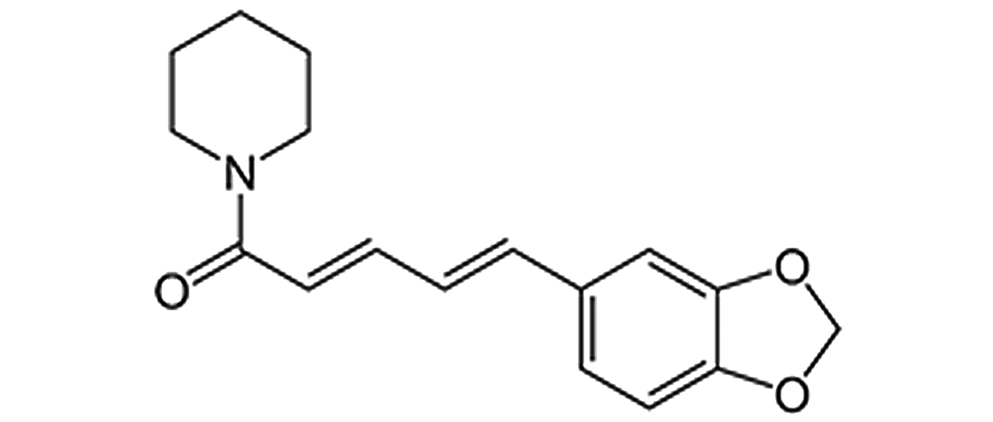
Piperine is the most abundant pungent alkaloid obtained from the fruits of P. nigrum L. and other peppers. It was first isolated by Hans Christian Ørsted in 1819 as yellow crystalline substance. Its structure was determined later. Its chemical formula is C17H19NO3 and its IUPAC name is 1-[5-(1, 3-benzodioxol-5-yl)-1-oxo-2, 4-pentadienyl] piperidine. It is slightly soluble in water and has the melting point of 128–130°C. It has 3 other geometric isomers, namely iso-piperine, chavicine and iso-chavicine, but all these lack pungency. Piperine has good pungent taste but on hydrolysis it gets converted to piperidine and piperic acid, due to which it loses its pungent nature. Piperine accounts for about 98% of the total alkaloids in peppers.6, 7
Other alkaloids reported in peppers containing characteristic pungency include piperanine, piperylin A, piperolein B, piperettine, and pipericine. However, these alkaloids make a small contribution to the total pungency of pepper. From the analysis of data obtained from gas chromatography-mass spectrometry (GC-MS) along with distillation–extraction of P. nigrum, it was concluded that vinylic volatile compounds are the predominant compounds present in pepper that are found in both white and black pepper.8 Jagella and Grosch concluded that compounds like α-pinene, β-pinene, limonene, α-phellandrene, myrcene, 2- and 3-methylbutanal, butyric acid, linalool, methyl propanol, and 3-methylbutyric acid are the predominant odorants present in P. nigrum.9 Figure 1 presents the chemical structure of piperine.
Extraction of piperine
Piperine is responsible for the pungency of many peppers such as black, white and long pepper. It is obtained essentially from the fruits of P. nigrum or P. longum, using various solvent extraction methods such as soaking, maceration and Soxhlet extraction. A wide range of solvents used for piperine extraction includes dichloromethane, petroleum ether, diethyl ether, alcoholic solvents like ethanol, hydrotropic solutions, and ionic-based solutions. Along with conventional extraction methods, the modern extraction techniques incorporated for piperine are supercritical carbon dioxide extraction, ultrasound-assisted extraction, pressurized liquid extraction, and microwave-assisted extraction. The dried fruits are pulverized and accurately weighed powder is used for extraction of piperine with dichloromethane at room temperature, with occasional stirring for 12 h, followed by filtration, vacuum concentration and then residue purification on an alumina column. Purified piperine can also be obtained by the crystallization from hydroalcoholic solutions and the treatment with aqueous alkali solutions.10 However, lesser amounts of piperine are attained from the crude residue by the aforementioned extraction with alcohol, filtration and then successive crystallization. Piperine can also be synthesized by the interaction of piperyl chloride (assembled from piperic acid and phosphorus pentachloride) and piperidine.
Medicinal use
Hepatoprotective activity
Piperine, when tested for treating acetaminophen-induced hepatotoxicity in mice, was found to decrease the levels of serums such as serum glutamic oxaloacetic transaminase (SGOT) and serum glutamic pyruvic transaminase (SGPT) in a dose-dependent manner.11 The hepatoprotective activity of the methanolic extract of P. nigrum was determined in treatment of ethanol-CCl4-induced hepatic damage in Wistar rats.12 The results of other study, concerning D-glucosamine-induced hepatotoxicity in mice, indicated that piperine possess a vast therapeutic potential in the treatment of liver disorders.13
Anti-diarrheal activity
In another study, aqueous extract of black pepper was prepared in doses of 75 mg/kg, 150 mg/kg and 300 mg/kg for testing. Then, it was evaluated for its anti-motility, anti-secretary and anti-diarrheal activity in mice. Diarrhea was induced for the evaluation of anti-diarrheal activity and gastrointestinal motility by employing castor oil and magnesium sulfate in mice. The anti-motility and anti-secretary activities of P. nigrum were attributed to the presence of alkaloids, mainly piperine.14
Antidepressant activity
The corticosterone-induced model of depression in mice was used to study the effects of piperine as antidepressant and its possible mechanism of action. In this study, corticosterone injections were given to mice for 3 weeks to induce depression, and the mice were observed for the decreased brain-derived neurotrophic factor protein and mRNA levels in the hippocampus. These changes disappeared after the mice had been treated with piperine. These results demonstrated that piperine has potential anti-depressive activity in the corticosterone-induced depression model in mice.15 Piperine also showed anti-depressive-like effects in mice with chronic mild stress.16
Immunomodulatory activity
Piperine was evaluated for its immunomodulatory and antitumor activities. It was found to be cytotoxic to Ehrlich ascites carcinoma (EAC) cells, known widely as Ehrlich cells and Dalton’s lymphoma ascites. Increased white blood cells (WBC), bone marrow cells and alpha esterase-positive cells count was observed in mice after treatment with piperine.17
Analgesic activity
In vivo evaluation of piperine was performed to determine the analgesic effects in acetic-acid induced writhing and tail flick assay models in mice. The acetic-acid induced writhing model showed a significant reduction after intraperitoneal administration of piperine in mice at dose of 30 mg/kg, 50 mg/kg and 70 mg/kg. Piperine showed greater inhibition when compared with indomethacin at a dose of 30 mg/kg administered intraperitoneally (ip.). In the tail flick assay, an ip. injection of piperine and morphine at doses of 30 mg/kg and 5 mg/kg, respectively, resulted in remarkable increase in reaction time.18
Anti-tubercular activity
In vitro evaluation of piperine was determined in a murine model of Mycobacterium tuberculosis infection. The results showed an increase in the secretion of Th1 cytokines (interferon gamma (IFN-γ) and interleukin 2 (IL-2)) and in macrophage activation.19
Effect of piperine on metabolism
Piperine regulates the metabolic pathway of many components inside the body and is also involved in altering the bioavailability of many therapeutically crucial drugs and nutrients. Through various mechanisms, it stimulates the absorption of drugs and other nutrients from the gastrointestinal tract. It works by changing the membrane dynamics, thus enhancing the permeability at the site of drug absorption. It is also responsible for extending the serum half-life of substances such as β-carotene and coenzyme Q10, and declining the metabolism of many drugs by handicapping metabolizing enzymes like cytochrome BS, uridine 5’-diphospho (UDP)-glucuronyltransferase, UDP-glucose dehydrogenase (UDP-GDH), CYP3A4, aryl hydrocarbon hydroxylase, and nicotinamide adenine dinucleotide phosphate (NADPH) cytochrome.20 Piperine has been reported to influence the bioavailability of many drugs such as amoxicillin, acefotaxime, norfloxacin,21 metronidazole, carbamazepine,22 oxytetracycline, pentobarbitone, phenytoin,23 resveratrol,24 β-carotene,25 curcumin, tiferron, nevirapine, docetaxel,26 theophylline, and propranolol.27 Hence, piperine is also known as bioavailability enhancer. The other uses of piperine are summarized in Table 1.
Antibacterial activity
Piperine and black pepper oil are powerful antibacterial agents – especially piperine, which is active against both Gram-positive and Gram-negative microorganisms.64
Appetite suppressant
The findings indicated that preloading with BPB (black pepper-based beverage) reduced hunger, desire to eat and prospective intake, while increasing satiety and a feeling of fullness. Thus, this demonstrates appetite suppressing action of piperine.65
Piperine enhances body efficiency
Piperine is an alkaloid present in black pepper (P. nigrum), long pepper (P. longum) and other species belonging to the Piperaceae family. It is responsible for the black pepper distinct biting quality. Piperine has many pharmacological effects, especially against chronic diseases, such as reducing insulin-resistance and anti-inflammatory effects, and mitigating hepatic steatosis.
Side effects
Major side effects of piperine include loss of potassium, acid reflux, constipation, and nausea. Pepper can cause allergic reactions like sneezing, hives, rashes, and swelling of the tongue and mouth, and even profound respiratory reactions in cases of severe allergic reactions.
Isolation of piperine
Several methods have been developed for the isolation of piperine from black pepper, namely Soxhlet extraction, hydrotropic extraction, supercritical fluid extraction, ionic liquid-based extraction, and microwave-assisted extraction. However, in one study, bulk isolation of piperine from black pepper and white pepper fruits was performed using Soxhlet extraction with 95% ethanol, and from the concentrated extracts, the yellow-colored needles were obtained, which were isolated by precipitation with 10% alcoholic potassium hydroxide (KOH) solution. It was then followed by purification by recrystallizing the obtained crystals with dichloromethane followed by few drops of n-Hexane that will lead to the formation of rod-like, pale yellow crystals of piperine.66
Conclusion
Based on an exhaustive review of literature, it may be concluded that piperine is a very promising alkaloid found in members of Piperaceae family. This review aimed to gather information about the biological source of piperine, its extraction and isolation strategies, physicochemical properties, and pharmacological activity. The effect of piperine on biotransformation of co-administered drugs is also presented in this review. The major mechanisms involved in its bioavailability-enhancing activity are: a) acting on drug metabolizing enzyme; b) disrupting the supply of blood to gastrointestinal tract and the membrane fluidity; c) affecting drug transport; and d) disturbing drug absorption.